Showing posts with label Qt. Show all posts

Monday, August 7, 2023

Summer releases 2023

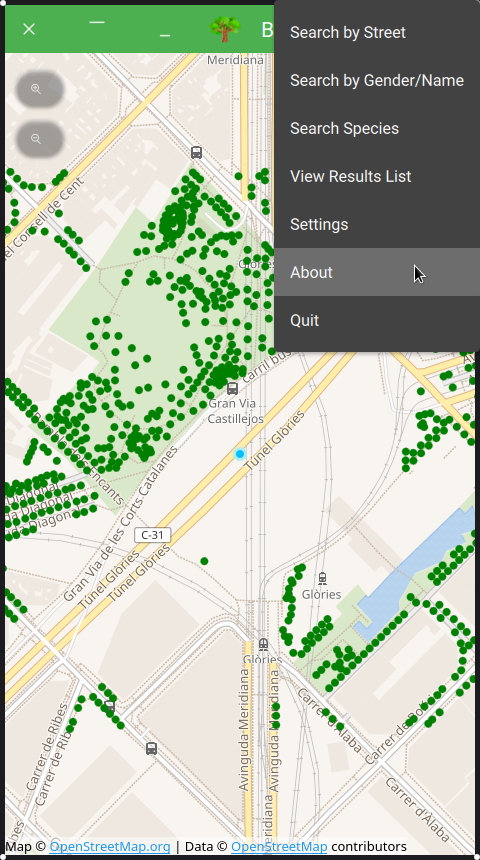
Barcelona Trees v0.0.5 has been released. This is the third Beta release of this program, that was already mentioned here some time ago. The new features are:

  • Database updated using the 2023_2T datasets from Open Data BCN
  • Added Dutch translation by @Vistaus: Thanks!
  • Window Client Side Decorations on all platforms (except Android)
  • Build system migrated to CMake
  • Git Submodules for android_openssl and libq7zip
  • Migrated to Qt 6.5.2

The last one is interesting, because the Location Maps were removed from Qt 6.0, but they came again in 6.5 so the migration was possible. Another interesting point is the new Dutch translation contributed by Heimen Stoffels. The Window CSD feature is based on the work of Johan Helsing, and it is available for Windows and Linux. It has the advantage of saving some screen space for the application window, providing a similar experience for all operating systems, and also similar to the Android interface…

But of course, the most important feature is the Database update from the Open Data BCN datasets. This time the number of catalogued trees is 232,260 and the number of species is 487. Impressive numbers! but you may think how accurate is this database. Well, I am somewhat disappointed in my personal experience. I’ve been testing the new version for some time, and discovered that a Ginkgo biloba supposedly at Taulat with Selva de Mar doesn’t exist anymore. Not even a stump!

And when checking two Metrosideros excelsa, on the Mar Bella promenade, I’ve found them dry dead. So sad! 😧

There are three more Metrosideros not far away that look healthy. Live long and prosper, dear Pohutukawas!🖖

Sunday, August 14, 2022

Drumstick Libraries 2.7.1 Released

Drumstick is a set of MIDI libraries using C++/Qt idioms and style. Includes a C++ wrapper around the ALSA library sequencer interface: ALSA sequencer provides software support for MIDI technology on Linux. A complementary library provides classes for processing SMF (Standard MIDI files: .MID/.KAR), RIFF MIDI (.RMI), and Cakewalk (.WRK) file formats. A multiplatform realtime MIDI I/O library and a GUI Widgets libraries are also provided for Linux, Windows, and Mac OSX.

This is another sonivox related release. Please see: https://github.com/pedrolcl/sonivox

I didn't want to make the sonivox dependency mandatory, because there may be good reasons for an user to avoid building drumstick with all its features. A final user may be interested in FluidSynth output only (which is also an optional feature) or even using ALSA sequencer only, without any soft-synth at all.

But what is a legitimate choice for a final user may be a questionable restriction for a distribution, because you may not know all use cases of your users. In this case, SonivoxEAS is the default Linux output for drumstick-vpiano and VMPK, because I think that any user installing those programs the first time should be able to hear sound by default, without needing to configure/investigate about MIDI or SoundFonts. Otherwise, there will be many users complaining that their Linux virtual pianos do not produce any sound!

On the other hand, until now the sonivox library sources were embedded inside the drumstick source tarballs, and statically linked to the SonivoxEAS backend. This was against most Linux distros packaging policy. Providing an standalone shared library instead, the issue has been fixed.

Changes in v2.7.1:

  • Fixed ticket #45: the sonivox library dependency (for the SonivoxEAS synth backend) is optional, and easily forgotten by 3rd party packagers. The build system configuration now fails with an error message if the sonivox library is missing unless the cmake variables USE_SONIVOX and USE_PULSEAUDIO are set to OFF. Same failure with the FluidSynth backend and the variable USE_FLUIDSYNTH, and the ipMIDI Network backend and USE_NETWORK.
  • Fixed underlinking in some RT backends.

Compilation minimum requirements for all platforms:

  • C++11 compiler
  • CMake 3.14
  • Qt5 >= 5.9 or Qt6 >= 6.2 (with Qt6Core5Compat library dependency for Drumstick::File)

Feature dependencies (for some platforms):

  • ALSA (Linux only)
  • PulseAudio (Unix)
  • D-Bus (Unix)
  • Sonivox (Unix)
  • FluidSynth (All platforms)

Copyright (C) 2009-2022, Pedro Lopez-Cabanillas License: GPL v3 or later

Project web site https://sourceforge.net/p/drumstick

Online documentation https://drumstick.sourceforge.io/docs/

Downloads https://sourceforge.net/projects/drumstick/files/2.7.1/

Thursday, August 11, 2022

Summer Releases

This week I have published several new versions of my music applications:

The first two applications, kmetronome and kmidimon, are now over fifteen years old and are only available for Linux. These two new versions are simply bug fixes, with no new features. But it is interesting to note that in FlatHub they are already based on Qt6 and supporting both Wayland and X11, although the packages in AppImage format still use Qt5. The chances of finding these applications in the official repositories of Linux distributions are slim. In fact, kmidimon was removed from the official Debian repositories with some lame excuse, and it is unlikely to be included again. I can't do anything about it, so please: direct complaints where they belong. Or use the new available distribution formats or the unofficial repositories, like Debian Multimedia, which includes the three mentioned applications and many others.

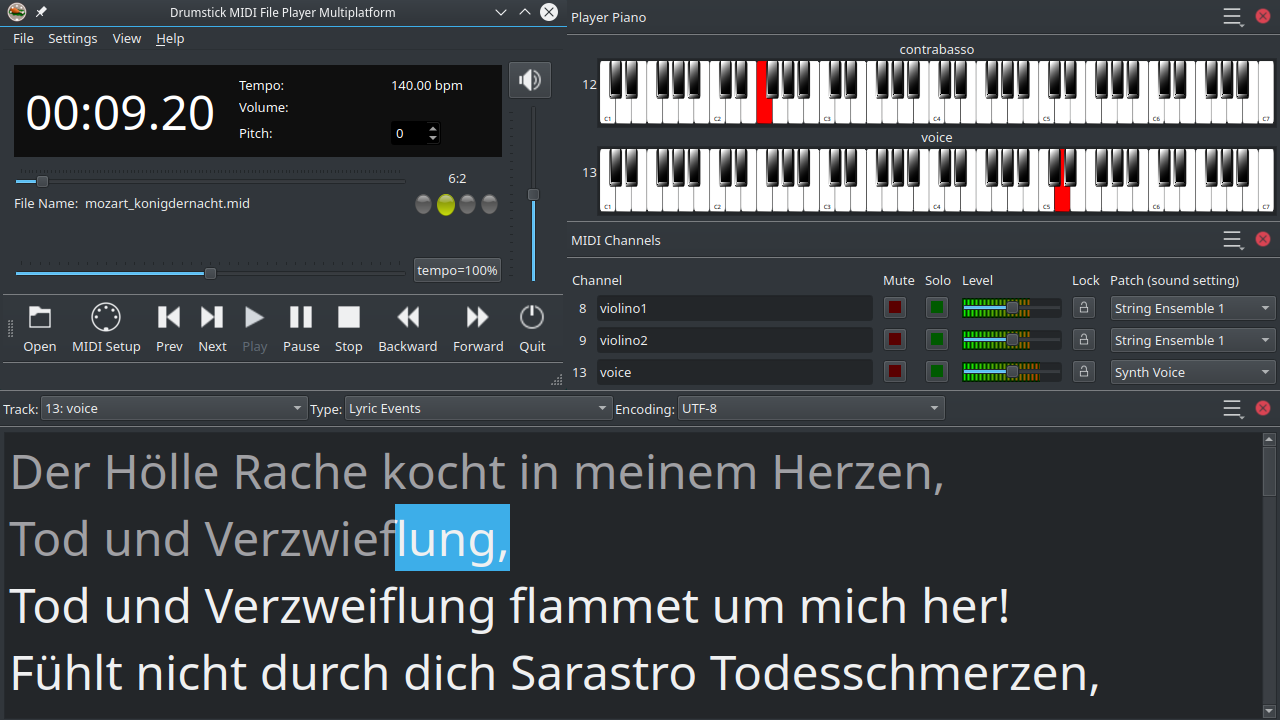
The other app, dmidiplayer, is much newer and cross-platform. It is the successor to Kmid2, the KDE karaoke application that I rewrote many years ago. In this new version the most remarkable new feature is the persistent configuration of the songs. This is a feature that was already present in the old Kmid2 and that allows you to store the tempo, general volume, pitch transposition, and MIDI channel settings for each song, which will be applied when it is played again in the future. The other novelty is the individual volume adjustment for each MIDI channel, something that was not possible in Kmid2.

After all these years, it is curious that it is still possible to find Kmid2 in one distribution: Fedora, despite being a Qt4/KDE4 application. So a functional comparison of both applications is not only possible, but easy to do. In my opinion, with this version dmidiplayer has reached parity in terms of functionality with Kmid2. On the other hand, the new architecture has allowed the application to be available on other Unixes (such as FreeBSD) in addition to Linux, macOS, and Windows.

I guess the next app to get updates will be VMPK. There is no forecast yet of the changes it will bring, but there is a recurring request that I will not do: MIDI Jack support. This is not to say that it is not possible to use Jack MIDI with VMPK, because in fact there is an utility called 'a2jmidid' that serves as a translation layer between applications using the ALSA Sequencer and Jack MIDI. On the other hand, for VMPK to use new native backends it is only necessary to implement Drumstick::RT plugins. And this can be done by any interested developer, and then independently distribute the out-of-tree plugins. I've opened a discussion on GitHub about this. Anyone interested, please read and ask your questions there.

Friday, March 18, 2022

Spring is coming

I've just released Barcelona Trees, Beta2 v0.0.4, which is just another extremely niche application, totally unrelated to MIDI, but also based on the Qt frameworks like my other free software projects.

The motivation of this program is to help Barcelona visitors or dwellers, answering questions such as:

  • What trees are nearby? (from manual or GPS location)
  • What trees are on a given street or garden?
  • Where can I find specimens of a certain genus/species?
  • For each specimen, obtain more information about its species from existing data on Wikipedia and public images.

screenshot

This may be useful in many ways, from Botany students to simply curious people. Barcelona has plenty of trees: almost 230k at this moment. And the Open Data BCN service periodically publishes several datasets cataloging the Geo-located specimens in public spaces that are used by this application.

Palau GC- tarongers0682-01

As an example, there are more than 3k Bitter Orange trees like the above (the Courtyard of the orange trees is not in a public place, it is inside an official building) used as ornamental. They are not edible in raw, but can be used for cooking. On the other hand, there are a few (dozens) other Citrus gender specimens that are truly edible, and you may find using the program. Enjoy!

Farewell

This release using Qt 5.15 may be the last one for this application. It won't be a Qt6 migration, because the Qt Location Maps have been removed in Qt6, but this may change in the future...

Another functionality lost in Qt6 is the QTextCodec class, removed from QtCore and moved to the Core5Compat module that has been already mentioned here, and provides conversion from many text encodings to Unicode. This issue has impacted applications reading MIDI files, and the Drumstick::File library. Well, I've tested two possible replacements...

iconv() is a POSIX API, and it is included in the C library of many Unix systems, like the GNU libc. This may be detected by cmake, and in this case no additional library needs to be linked to the application program, but the external libiconv is also supported when needed.

Character set detection was never provided by Qt. The iconv() POC uses the latest uchardet library (0.0.7 at the time of writing this), which only supports pkg-config. A newer version will include also support for find_package() and imported targets. On the other hand, libICU provides charset detection in addition to Unicode conversion.

Sunday, December 26, 2021

Winter Releases

In addition to the usual bug fixing, a common pattern across all projects are the changes related to the transition to Qt6, still experimental but mature enough, while keeping compatibility with Qt5. One stopper in this transition is the removal of the QTextCodec class in Qt6 core libraries, moved to the Core5Compat module, risking to be definitely removed at some point in the future. Some methods in Drumstick::File that depend on this class are deprecated now. This functionality is key for data preservation when parsing/importing MIDI files containing text metadata (titles, comments, names, copyrights, lyrics, markers, ...) encoded in any random scheme available in the last 30 years. But the alternative in Qt6 is the QStringConverter and related classes that only supports a very limited set of encodings, mostly Unicode.

This problem deserves deeper thoughts...

If we were talking about pure text files, this could be solved using for instance the iconv command line Unix utility, that converts text files from one encoding to another, for instance from ISO-8859-5 (Cyrillic alphabet) to UTF-8. Then, the new text file encoded in Unicode could be processed by a Qt6 program without limitations. But MIDI files are compact binary structures that can't be processed directly with that utility.

The second root of the problem comes from the SMF nature itself. The Standard MIDI File format was created as an interchange file format, so the music created in sequencers using proprietary storage formats could be exported and retrieved by another sequencer. Sequencer machines and software at one point become deprecated, stopping to work, and can't be used anymore. Composition files created in those systems are now digital garbage for the trash bin, except if the author took the precaution of keeping exported MIDI files. Those are now the equivalent of modern digital manuscripts, which we try to preserve and keep them readable for the foreseeable future within our musical applications.

Changes in Virtual MIDI Piano Keyboard v0.8.6:

  • Fixed advanced setting on connections dialog.
  • Enabled empty input connection after fix on drumstick-ALSA: requires external connections utility.
  • Better inverted piano colors after fix on drumstick-widgets: changed the white keys background picture depending on the key background color.
  • Removed dependency on Qt6::Core5Compat when building with Qt6
  • Requires: drumstick-2.5

Downloads: http://sourceforge.net/projects/vmpk/files/0.8.6/

Changes in Drumstick MIDI Player v1.5.3:

  • After drumstick ticket #37: WRK format markers are supported
  • Replaced deprecated signals from drumstick-file when building with Qt6
  • Requires: drumstick-2.5

Downloads: https://sourceforge.net/projects/dmidiplayer/files/v1.5.3/

Changes in Drumstick Metronome 1.3.0

  • Czech translation updated, by Pavel Fric
  • Qt6 compatibility fixes
  • New build options: USE_QT and BUILD_DOCS
  • Revised and updated documentation system: using Pandoc to create man page and help documents
  • New settings: qt style, forced dark mode, and internal icon theme
  • Added action icons: internal theme based on breeze
  • Desktop icon replaced

Downloads: https://sourceforge.net/projects/kmetronome/files/kmetronome/1.3.0/

Changes in Drumstick MIDI Monitor v1.2.0

  • Czech translation updated, by Pavel Fric
  • Revised and updated documentation system: using Pandoc to create man page and help documents
  • New build options: USE_QT and BUILD_DOCS
  • Qt6 compatibility fixes
  • Save recording fixes
  • Fixed mute track functionality
  • Fixed event playback highlighting
  • Support WRK file format markers, provided by Drumstick 2.5
  • Desktop icon replaced

Downloads: https://sourceforge.net/projects/kmidimon/files/1.2.0/

Changes in WRK2MID v1.1.0

  • New build option: BUILD_DOCS.
  • New Build option: USE_QT to choose between Qt5 and Qt6. Closes ticket #3.
  • Convert WRK track Port parameter. Closes ticket #2.
  • Convert WRK markers into SMF text markers. Closes ticket #1.
  • Displayed compiled and runtime library version information.

Downloads: https://sourceforge.net/projects/wrk2mid/files/v1.1.0/

Changes in Drumstick Libraries v2.5.0:

  • New build options: BUILD_ALSA, BUILD_FILE, BUILD_RT, BUILD_WIDGETS to control building only some of the libraries.
  • RT, VPiano: Fixed ALSA and CoreMIDI backends, enabling empty connections (for using external connection tools).
  • Deprecation of the Drumstick::File functions affected by the QTextCodec class removal on Qt6.
  • Raised macOS deployment target to 10.13 (High Sierra).
  • Widgets: changed the white keys background picture depending on the key background color.
  • VPiano: new option to display inverted key colors.
  • File: WRK format markers processing. Closes ticket #37.

Downloads: https://sourceforge.net/projects/drumstick/files/2.5.0/

Saturday, May 15, 2021

Drumstick Multiplatform MIDI File Player, Released and Reloaded

Drumstick Multiplatform MIDI File Player 1.3.0 has been released this week, right after the Drumstick Libraries 2.2.0 and VMPK 0.8.3; business as usual: we write programs, we release stuff. This post is about the first program, a MIDI file player (reloaded). Let's start by the beginning...

10 years ago, there was not a fully featured MIDI file player for Linux. Of course, there was Linux software that could (barely) play MIDI files, but nothing comparable to the vanBasco MIDI Karaoke player (which is a Windows 32 bit application, updated the last time in 2006). This program can be run in Wine, by the way. The key features of the vanBasco player are described in its site, and anyone with a musical background can identify its value, beyond the entertainment use case:

  • lyrics can be displayed in a resizable window or full-screen
  • control window: ability to change tempo, volume, key of song
  • real-time MIDI output window: shows notes, volumes, and instruments, can mute or play solo individual instruments
  • piano view: displays notes on a big piano keyboard

The KDE 4 desktop was starting to become mature and stable at the time, so I've decided to scratch my itch rewriting the old and abandoned KMid  application, adding my favorite features from vanBasco. This was already told on this blog a few times. KMid2 was a total rewrite almost from scratch, with the additional goal to make it multiplatform. Indeed, it was possible to build and run it on Linux, macOS and Windows, but there wasn't an easy way to deploy KDE programs on macOS and Windows at the time, so the only viable target was Linux. On the other hand, because the chosen architecture, it  was difficult to maintain and port the program to other platforms. Then, several Linux distributions boycotted this application, with the total indifference of the KDE community. Good riddance.

Fast forward to the roaring twenties. Nothing changed for Linux. The vanBasco player is still the king in the Windows world. In spite of most Windows 10 users running a 64 bit Operating System, vanBasco is rotting its 32 bits. The only alternative fulfilling the four mentioned features is Falcosoft MIDI player. I don't know about native macOS alternatives, either. Of course there are players for macOS, and WinAmp for Windows, and even VLC plays MIDI files, but that is not what I'm talking about...

I prefer to avoid hard use cases. Someone asked me once about my VMPK program: how it would be classified? Is it a Game? No, it is not a game, it is a toy! A game has a set of rules that the player must follow to reach the final goal: to win the game. On the other hand, a toy has no written rules. The player can explore, learn, and have fun on its own. No winners, no losers. Sometimes a good game may be repurposed by the users, like Wolfenstein 3D, but it is uncommon. It is in the definition of free software: the freedom to run the program as you wish, for any purpose.

Anyway, here is an usage example for this program: there is a choir, with a conductor or composer that arranges or edits pieces using some MIDI software like Rosegarden, MuseScore, Frescobaldi, or similar. He prints the scores (or exports PDF files for electronic distribution) for the singers. He also exports the pieces as MIDI files, that can be loaded by dmidiplayer, and used by the singers to learn and practice the lyrics and music of each voice. The examples in dmidiplayer include some choral music, edited in Rosegarden and directly exported as MIDI files.

You can download this program for free, either as sources that you may study, modify and build, or an AppImage for any Linux distro, or as ready to install packages for Windows, and macOS, from Sourceforge and GitHub.

There is also a Flatpak available at Flathub. And thanks to deb-multimedia, there are also deb packages for Debian and Ubuntu users.
Sunday, April 3, 2016

Taking Back From Android


Android is an operating system developed by Google around the Linux kernel. It is not like any other Linux distribution, because not only many common subsystems have been replaced by other components, but also the user interface is radically different based on Java language running into a virtual machine called Dalvik.

An example of subsystem removed from the Linux kernel is the ALSA Sequencer, which is a key piece for MIDI input/output with routing and scheduling that makes Linux comparable in capabilities to Mac OSX for musical applications (for musicians, not whistlers) and years ahead of Microsoft Windows in terms of infrastructure. Android did not offer anything comparable until Android 6 (Marshmallow).

Another subsystem from userspace Linux not included in Android is PulseAudio. Instead, OpenSL ES that can be found on Android for digital audio output and input.

But Android also has some shining components. One of them is Sonivox EAS (originally created by Sonic Network, Inc.) released under the Apache 2 license, and the MIDI Synthesizer used by my VMPK for Android application to produce noise. Funnily enough, it provided some legal fuel to Oracle in its battle against Google, because of some Java binding sources that were included in the AOSP repositories. It is not particularly outstanding in terms of audio quality, but has the ability of providing real time wavetable GM synthesis without using external soundfont files, and consumes very little resources so it may be indicated for Linux projects on small embedded devices. Let's take it to Linux, then!

So the plan is: for the next Drumstick release, there will be a Drumstick-RT backend using Sonivox EAS. The audio output part is yet undecided, but for Linux will probably be PulseAudio. In the same spirit, for Mac OSX there will be a backend leveraging the internal Apple DLS synth. These backends will be available in addition to the current FluidSynth one, which provides very good quality, but uses expensive floating point DSP calculations and requires external soundfont files.

Meanwhile, I've published on GitHub this repository including a port of Sonivox EAS for Linux with ALSA Sequencer MIDI input and PulseAudio output. It also  depends on Qt5 and Drumstick. Enjoy!

Sonivox EAS for Linux and Qt:
https://github.com/pedrolcl/Linux-SonivoxEas

Related Android project:
https://github.com/pedrolcl/android/tree/master/NativeGMSynth

Sunday, September 14, 2014

Notes about VMPK 0.6.0 for Desktops

Dear Blog,

It has been a long time, but a week later after the release it is time to discuss some aspects of the latest version of our Virtual MIDI Piano Keyboard for desktop computers.

Where to start? an interesting point is the change of architecture with the replacement of RtMIDI by Drumstick-RT. This library is new and homegrown, part of the Drumstick family which includes Drumstick-File and Drumstick-ALSA as well. The motivation to create it was the difficulty of extending RtMIDI with other drivers different to the ones chosen by his author. This was not a problem in the past, because the RtMIDI sources were always included in the application, and any customization was possible and easy. Now, thanks to the Taliban of Linux distributions forcing the dynamic linking of RtMIDI this is simply not feasible - to the hell with the freedom of Free Software!. Throwing away the ipMIDI backend was not an option. On the other hand, with Drumstick RT is not only possible, but new backends can be compiled separately and installed in the system without recompiling neither VMPK nor Drumstick, because they are in fact plugins. By chance it also has fixed the bug reported (in 2009!) in ticket #15: LinuxSampler did not appear among ALSA connections, because LinuxSampler MIDI port has no flag providing proper characterization and RtMIDI (unlike Drumstick RT) filters out that port.

The replacement of the RtMIDI library with Drumstick-RT was a long time plan, not only for VMPK, but for Drumstick as well, that finally took place now. I hope that this shall be a foundation for features like recording/playback in the future. The only thing that maybe would be missing for some users is the jack-midi interface, but on the other hand Unix users will enjoy native OSS support, and also FluidSynth direct output on all operating systems, meaning  also configurable SoundFonts: a very demanded feature for Windows users.

Another long time request finally implemented is the ability of displaying any number of keys, for instance 88 keys, instead of full octaves, starting with any arbitrary white note (ticket #39), like configuring 25 or 49 keys (depending on which device, laptop or tablet, and screen size you have). Congratulations to all the requesters and sorry for keeping you waiting for this feature so long.

Finally, the migration to Qt5 has happened. This means also replacing a dependency from Xlib to XCB, that hopefully will bring future support for wayland/whatever. The victim has been the keyboard grabbing feature, that was only working on Linux thanks to a now lost X11/Qt4 feature. I hope to bring it back in the future with a multiplatform implementation.

There are now binary packages for 32/64 bit Linux users that shall work on any modern distribution, in the form of installers packaged using the excellent BitRock InstallBuilder. That means including all the required dependencies inside the package, in the same way the libraries are included in the Windows and Mac OS X setup packages. In order to reduce the package weight, superfluous things like Jack support were excluded, because the new FluidSynth backend is intended to provide instant audio out of the box without requiring the users to search, find, ask, learn, install, try and tweak. Something that traditional Linux distributions have failed to do, in despite of their duty of integration and making the life easier to their users. I am pretty sure that many Linux distros will fail to provide VMPK native packages for this release like they did for the 0.5.x  series (see Debian, Ubuntu and Fedora repositories for instance). Prove me wrong, and this kind of binary Linux packages would be deprecated.

Wednesday, October 12, 2011

VMPK & FluidSynth 0.1.0 released

VMPK & FluidSynth is a MeeGo Harmattan application for Nokia N9/N950 smartphones. It contains a  QML based VMPK user interface bundled with FluidSynth for sound generation.

You may download it from OVI Store right now.

Several enhancements have been included since the 0.0.1 beta announced in August.
  • Controllers, Bender, and Velocity values can be optionally controlled by the device's accelerometer.
  • Internationalization. This version includes translations to Spanish, Russian (thanks to Serguey Basalaev) and Czech (thanks to Pavel Fric).
  • Inverted color theme. This dark color combination consumes less power, enabling longer battery life.
  • Latest FluidSynth included.
Sources available at SourceForge.net, as usual.


Saturday, August 27, 2011

Presenting VMPK for Nokia N950

I've been playing with my new and sexy Nokia N950 developer device, and here is the fruit: a newborn VMPK. I've just released a beta for testing, usable but not yet optimized. Please, try it. Your feedback will be appreciated.

Download VMPK & FluidSynth for N950 from sourceforge.net

I've learned two lessons from the Symbian port of VMPK published at Nokia's OVI Store: people expect that if a program looks like a piano, it should sound like a piano. It doesn't matter if the product description says that it doesn't produce any sound by itself. Dozens of comments in OVI Store page confirm that there is no hope that users read the description before downloading a program.

When I was doing some research for the Symbian port, I've discovered that creating sound always used very large audio buffers, no matter the method, producing about one second of latency or more. This is unacceptable for a musical instrument emulation, so network MIDI was the only available option. On the other hand, the Nokia N9xx uses Linux, including ALSA and PulseAudio among other usual infrastructure, so the latency is not a problem and FluidSynth is a perfectly sound complementary addition to VMPK.

Second lesson: an user interface that fits well in the desktop version of the program is barely usable on the mobile phone form factor. The solution is to create a new user interface using QML, the new declarative language for Qt user interfaces. The piano keyboard widget was already built around the Qt Graphics View Framework, so it only required to be wrapped as a QDeclarativeItem subclass and it was readily available as a QML object, to be combined with the Qt Quick Components for Meego library to build the new user interface. Here are some screenshots.

Main page, common controls are shown.

Main menu, note names option activated.

Preferences page.

About page.

Wednesday, May 4, 2011

VMPK: new release, soon

A new VMPK release is coming, with some new features:

* Touch screen interface support.

* RtMidi 1.0.14, comes with Jack MIDI support. Note that RtMidi allows only one driver, so you need to choose at configuring time the desired MIDI backend.

* Network MIDI support (UDP multicast). It may be used in Linux, Windows and Mac, but is more interesting for portable devices. The protocol is compatible with ipMIDI for Windows and Mac (http://nerds.de) and with qmidinet and multimidicast in Linux/Unix (http://qmidinet.sourceforge.net).

* Symbian^3 port.

Sunday, April 3, 2011

Symbian ports

I want to start this post with my biggest kudos to Nokia. I've been accepted in the Qt Ambassadors Program and VMPK is now in the Ambassador Showcase among other great Qt applications.

Not only that, they have sent me a great Nokia C7-00 smartphone as a gift. This device uses Symbian^3 and can be programmed using Qt. It has a touchscreen with two concurrent touch points. Just what I wanted for VMPK! So there is hope that the next VMPK release will enjoy multitouch support, thanks to Qt and Nokia.

There will be also a Symbian port of VMPK, but some tests using the device's MIDI synthesizer and a few other tests show that the audio latency is so big that it is unbearable for real time usage. Another direction to explore is the wireless network, to send MIDI data using for instance a protocol based on UDP multicast like QMidiCtl, a program by our fellow Qt Ambassador Rui Nuno Capela.

QMidiCtl was created for Maemo, and it is available for Nokia N900 devices. It can be compiled also in Linux and Windows, but required a few adaptations for Symbian. Anyway, it works well in my C7 and here is a proof


I've tested it sending MIDI events to Linux, Windows and Mac OSX. The complementary software for Linux is QMidiNet, also made by Rui. It is compatible with IpMIDI by nerds.de that is available for Windows and Mac OSX. This may open interesting possibilities for VMPK not only on smartphones, but also on netbooks and tablets...