Showing posts with label MuseScore. Show all posts

Saturday, May 15, 2021

Drumstick Multiplatform MIDI File Player, Released and Reloaded

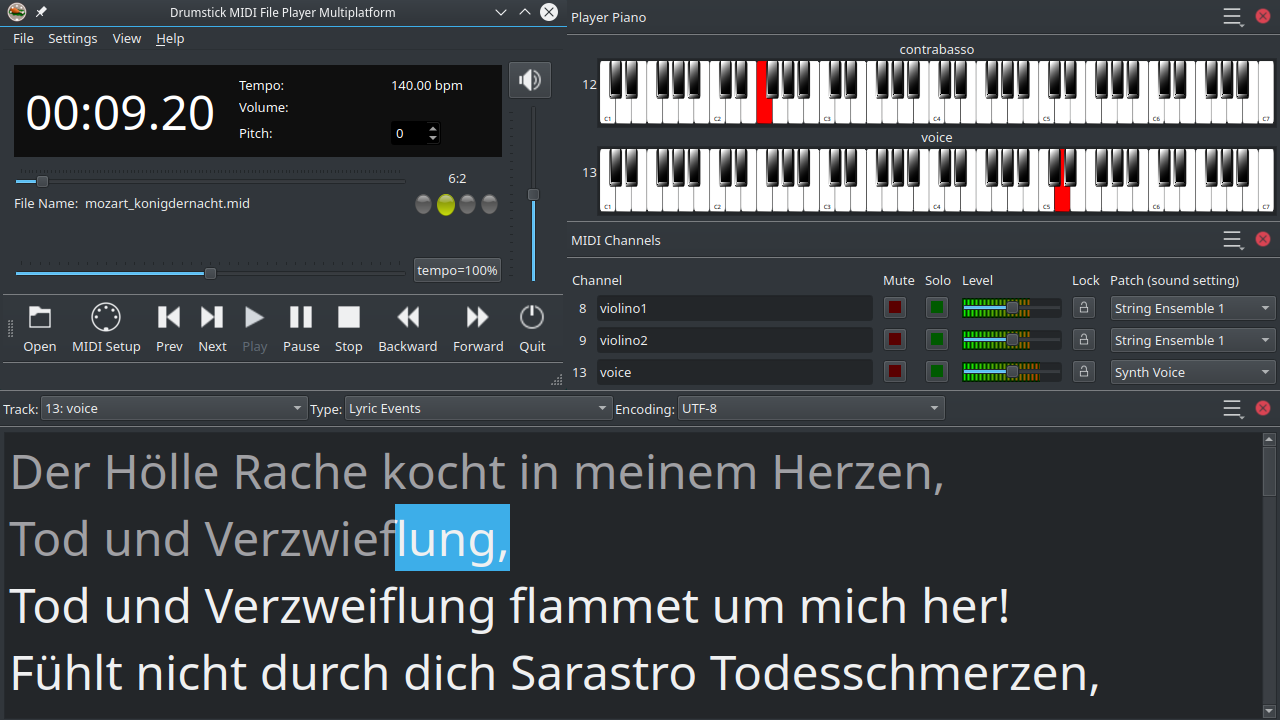
Drumstick Multiplatform MIDI File Player 1.3.0 has been released this week, right after the Drumstick Libraries 2.2.0 and VMPK 0.8.3; business as usual: we write programs, we release stuff. This post is about the first program, a MIDI file player (reloaded). Let's start by the beginning...

10 years ago, there was not a fully featured MIDI file player for Linux. Of course, there was Linux software that could (barely) play MIDI files, but nothing comparable to the vanBasco MIDI Karaoke player (which is a Windows 32 bit application, updated the last time in 2006). This program can be run in Wine, by the way. The key features of the vanBasco player are described in its site, and anyone with a musical background can identify its value, beyond the entertainment use case:

  • lyrics can be displayed in a resizable window or full-screen
  • control window: ability to change tempo, volume, key of song
  • real-time MIDI output window: shows notes, volumes, and instruments, can mute or play solo individual instruments
  • piano view: displays notes on a big piano keyboard

The KDE 4 desktop was starting to become mature and stable at the time, so I've decided to scratch my itch rewriting the old and abandoned KMid  application, adding my favorite features from vanBasco. This was already told on this blog a few times. KMid2 was a total rewrite almost from scratch, with the additional goal to make it multiplatform. Indeed, it was possible to build and run it on Linux, macOS and Windows, but there wasn't an easy way to deploy KDE programs on macOS and Windows at the time, so the only viable target was Linux. On the other hand, because the chosen architecture, it  was difficult to maintain and port the program to other platforms. Then, several Linux distributions boycotted this application, with the total indifference of the KDE community. Good riddance.

Fast forward to the roaring twenties. Nothing changed for Linux. The vanBasco player is still the king in the Windows world. In spite of most Windows 10 users running a 64 bit Operating System, vanBasco is rotting its 32 bits. The only alternative fulfilling the four mentioned features is Falcosoft MIDI player. I don't know about native macOS alternatives, either. Of course there are players for macOS, and WinAmp for Windows, and even VLC plays MIDI files, but that is not what I'm talking about...

I prefer to avoid hard use cases. Someone asked me once about my VMPK program: how it would be classified? Is it a Game? No, it is not a game, it is a toy! A game has a set of rules that the player must follow to reach the final goal: to win the game. On the other hand, a toy has no written rules. The player can explore, learn, and have fun on its own. No winners, no losers. Sometimes a good game may be repurposed by the users, like Wolfenstein 3D, but it is uncommon. It is in the definition of free software: the freedom to run the program as you wish, for any purpose.

Anyway, here is an usage example for this program: there is a choir, with a conductor or composer that arranges or edits pieces using some MIDI software like Rosegarden, MuseScore, Frescobaldi, or similar. He prints the scores (or exports PDF files for electronic distribution) for the singers. He also exports the pieces as MIDI files, that can be loaded by dmidiplayer, and used by the singers to learn and practice the lyrics and music of each voice. The examples in dmidiplayer include some choral music, edited in Rosegarden and directly exported as MIDI files.

You can download this program for free, either as sources that you may study, modify and build, or an AppImage for any Linux distro, or as ready to install packages for Windows, and macOS, from Sourceforge and GitHub.

There is also a Flatpak available at Flathub. And thanks to deb-multimedia, there are also deb packages for Debian and Ubuntu users.
Sunday, September 11, 2011

SoundFonts want to be free

A "SoundFont" file  (suffix .SF2) is a definition of one or several musical instruments, which can be used with synthesizers (hardware or software) to render, or convert musical notes (eg MIDI files, suffix. MID) into digital sound, which can be used by an audio interface and speakers to play music. Another file format for the same purpose is DownLoadableSounds (suffix. DLS). Both include sound samples that can be entirely synthetic or digitized from real instruments.

General MIDI is a very popular specification, that among other things define a palette of instruments. The instrument #1 is a piano, #41 a violin, #57 trumpet, #74 flute... GM SoundFonts offer 128 instruments arranged in that particular order. GS and XG are extensions of this specification.

Linux needs GM soundfonts that could be distributed together with GPL programs, similar to the need of typographic fonts for text rendering applications. Many Linux distributions incorporate the FluidR3 soundfont in their repositories. It is free and produce good quality sound, but is not small: more than 140 megabytes. MuseScore distributes "TimGM6mb" soundfont, which "only" weights 5.8 megabytes.

There are several software synthesizers using SoundFonts. Well known are FluidSynth and TiMidity++, both with free licenses. One lesser known, but no less interesting, is Gervill. It is part of OpenJDK, and therefore GPLv2 licensed. It is implemented in Java, of course. I am not very fond of Java, and I do not usually use it except for commercial projects when the customer requires their use, but this time I will do it only for fun.

Gervill can use SoundFonts, DLS, or WAV files. A very interesting feature is the so-called "Emergency Soundbank", used when no other external SoundFont is available. Definitions of this SoundFont instruments are fully synthetic and follow the GM standard.

This EmergencySoundbank is a Java class, and does not reside on a file, therefore it can not be used on another synthesizer. However, nothing prevents us from creating a Java program that instantiates the class, and stores the instrument definitions on a disk file. How complicated may this program be? Let's see:

$ cat MakeEmergencySoundfont.java
import com.sun.media.sound.*;
public class MakeEmergencySoundfont {
        public static void main(String[] args) throws Exception {
                SF2Soundbank sf2 = EmergencySoundbank.createSoundbank();
                sf2.save("GervillEmergencySoundbank.sf2");
        }
}


7 lines is not much after all. Let's compile it:

$ javac MakeEmergencySoundfont.java
MakeEmergencySoundfont.java:5: warning: com.sun.media.sound.SF2Soundbank is internal proprietary API and may be removed in a future release
                SF2Soundbank sf2 = EmergencySoundbank.createSoundbank();
                ^
MakeEmergencySoundfont.java:5: warning: com.sun.media.sound.EmergencySoundbank is internal proprietary API and may be removed in a future release
                SF2Soundbank sf2 = EmergencySoundbank.createSoundbank();
                                   ^
2 warnings


We have earned two warnings for the naughty boys, because it is ugly to directly use classes in the namespace "com.sun.media.sound.*", and if the Oracle finds out our prank, he could lock the pantry. Here, take another cookie, Neo...

To compile and use this program you only need OpenJDK6 (runtime and compiler). For older Java versions you can get a "gervill.jar" from the project website.

Running the program produces a SoundFont file:


$ java MakeEmergencySoundfont
$ ls GervillEmergencySoundbank.sf2
-rw------- 1 pedro users 1.8M 2011-09-11 12:50 GervillEmergencySoundbank.sf2


The result weights less than 2 megabytes. Of course the quality of the SoundFont is not high, but it is better than installing nothing at all by default, leaving users wondering what do they need to hear something in their programs that depend on software synthesizers.

It is interesting that a similar technique, also very simple, can be used to produce other SoundFonts based on samples of arbitrary sounds. For more details, see the MakeSoundFont example in Gervill's repository.

Finally, a question remains about what license we can use to distribute the file "GervillEmergencySoundbank.sf2" generated by our program. As a general rule, the output of a GPL program has no restrictions. However, in this case the program output does not come from processing input data, but simply dumps the results of running the algorithms included in the EmergencySoundbank class. To play it safe, we should release it as GPL.