Showing posts with label KMid2. Show all posts

Thursday, August 11, 2022

Summer Releases

This week I have published several new versions of my music applications:

The first two applications, kmetronome and kmidimon, are now over fifteen years old and are only available for Linux. These two new versions are simply bug fixes, with no new features. But it is interesting to note that in FlatHub they are already based on Qt6 and supporting both Wayland and X11, although the packages in AppImage format still use Qt5. The chances of finding these applications in the official repositories of Linux distributions are slim. In fact, kmidimon was removed from the official Debian repositories with some lame excuse, and it is unlikely to be included again. I can't do anything about it, so please: direct complaints where they belong. Or use the new available distribution formats or the unofficial repositories, like Debian Multimedia, which includes the three mentioned applications and many others.

The other app, dmidiplayer, is much newer and cross-platform. It is the successor to Kmid2, the KDE karaoke application that I rewrote many years ago. In this new version the most remarkable new feature is the persistent configuration of the songs. This is a feature that was already present in the old Kmid2 and that allows you to store the tempo, general volume, pitch transposition, and MIDI channel settings for each song, which will be applied when it is played again in the future. The other novelty is the individual volume adjustment for each MIDI channel, something that was not possible in Kmid2.

After all these years, it is curious that it is still possible to find Kmid2 in one distribution: Fedora, despite being a Qt4/KDE4 application. So a functional comparison of both applications is not only possible, but easy to do. In my opinion, with this version dmidiplayer has reached parity in terms of functionality with Kmid2. On the other hand, the new architecture has allowed the application to be available on other Unixes (such as FreeBSD) in addition to Linux, macOS, and Windows.

I guess the next app to get updates will be VMPK. There is no forecast yet of the changes it will bring, but there is a recurring request that I will not do: MIDI Jack support. This is not to say that it is not possible to use Jack MIDI with VMPK, because in fact there is an utility called 'a2jmidid' that serves as a translation layer between applications using the ALSA Sequencer and Jack MIDI. On the other hand, for VMPK to use new native backends it is only necessary to implement Drumstick::RT plugins. And this can be done by any interested developer, and then independently distribute the out-of-tree plugins. I've opened a discussion on GitHub about this. Anyone interested, please read and ask your questions there.

Saturday, May 15, 2021

Drumstick Multiplatform MIDI File Player, Released and Reloaded

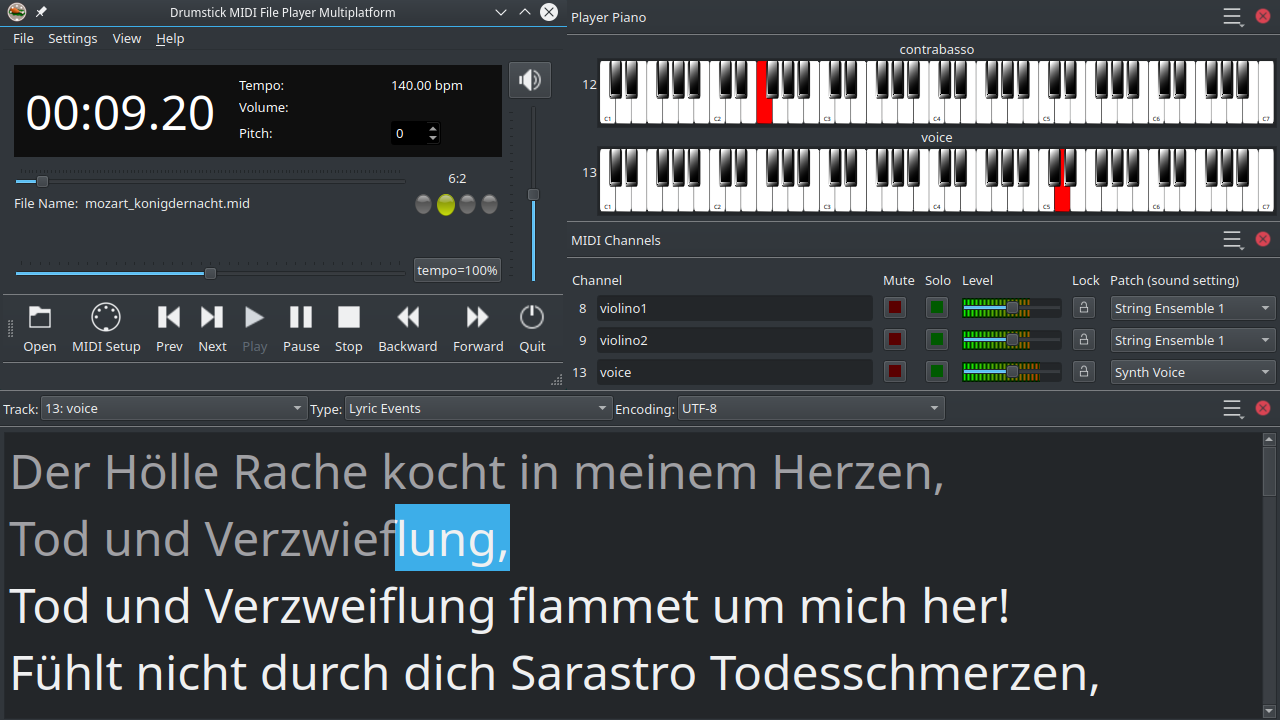
Drumstick Multiplatform MIDI File Player 1.3.0 has been released this week, right after the Drumstick Libraries 2.2.0 and VMPK 0.8.3; business as usual: we write programs, we release stuff. This post is about the first program, a MIDI file player (reloaded). Let's start by the beginning...

10 years ago, there was not a fully featured MIDI file player for Linux. Of course, there was Linux software that could (barely) play MIDI files, but nothing comparable to the vanBasco MIDI Karaoke player (which is a Windows 32 bit application, updated the last time in 2006). This program can be run in Wine, by the way. The key features of the vanBasco player are described in its site, and anyone with a musical background can identify its value, beyond the entertainment use case:

  • lyrics can be displayed in a resizable window or full-screen
  • control window: ability to change tempo, volume, key of song
  • real-time MIDI output window: shows notes, volumes, and instruments, can mute or play solo individual instruments
  • piano view: displays notes on a big piano keyboard

The KDE 4 desktop was starting to become mature and stable at the time, so I've decided to scratch my itch rewriting the old and abandoned KMid  application, adding my favorite features from vanBasco. This was already told on this blog a few times. KMid2 was a total rewrite almost from scratch, with the additional goal to make it multiplatform. Indeed, it was possible to build and run it on Linux, macOS and Windows, but there wasn't an easy way to deploy KDE programs on macOS and Windows at the time, so the only viable target was Linux. On the other hand, because the chosen architecture, it  was difficult to maintain and port the program to other platforms. Then, several Linux distributions boycotted this application, with the total indifference of the KDE community. Good riddance.

Fast forward to the roaring twenties. Nothing changed for Linux. The vanBasco player is still the king in the Windows world. In spite of most Windows 10 users running a 64 bit Operating System, vanBasco is rotting its 32 bits. The only alternative fulfilling the four mentioned features is Falcosoft MIDI player. I don't know about native macOS alternatives, either. Of course there are players for macOS, and WinAmp for Windows, and even VLC plays MIDI files, but that is not what I'm talking about...

I prefer to avoid hard use cases. Someone asked me once about my VMPK program: how it would be classified? Is it a Game? No, it is not a game, it is a toy! A game has a set of rules that the player must follow to reach the final goal: to win the game. On the other hand, a toy has no written rules. The player can explore, learn, and have fun on its own. No winners, no losers. Sometimes a good game may be repurposed by the users, like Wolfenstein 3D, but it is uncommon. It is in the definition of free software: the freedom to run the program as you wish, for any purpose.

Anyway, here is an usage example for this program: there is a choir, with a conductor or composer that arranges or edits pieces using some MIDI software like Rosegarden, MuseScore, Frescobaldi, or similar. He prints the scores (or exports PDF files for electronic distribution) for the singers. He also exports the pieces as MIDI files, that can be loaded by dmidiplayer, and used by the singers to learn and practice the lyrics and music of each voice. The examples in dmidiplayer include some choral music, edited in Rosegarden and directly exported as MIDI files.

You can download this program for free, either as sources that you may study, modify and build, or an AppImage for any Linux distro, or as ready to install packages for Windows, and macOS, from Sourceforge and GitHub.

There is also a Flatpak available at Flathub. And thanks to deb-multimedia, there are also deb packages for Debian and Ubuntu users.

Sunday, November 2, 2014

Drumstick Metronome (kmetronome 1.0.0) and Drumstick 1.0.0 Libraries in the Whole Picture

I've released in the past weeks some things labeled "Drumstick" and also labeled "1.0.0". What is all this about?

Drumstick is the name of a set of Qt based libraries for MIDI processing. Current major version of the Qt Frameworks is 5, which are binary incompatible with the older Qt4 libraries. Latest Qt4 based drumstick release was 0.5.0 published in 2010. Newest Qt5 based release is 1.0.0, published on August 30 2014.

Drumstick 1.0.0 is not binary compatible with the older one, nor even fully source compatible. In addition, it contains a new "drumstick-rt" library which is a cross-platform MIDI input-output abstraction. Based on Drumstick 1.0.0 I've released two more applications: vmpk 0.6.0 and kmetronome 1.0.0 (now renamed as "Drumstick Metronome").

There are other applications based on the old drumstick 0.5.0 libraries out there: kmid2 and kmidimon. I'm no longer the kmid2 maintainer, but I will release (time permitting) a "Drumstick Karaoke" application replacing kmid2, and of course also a new kmidimon (naming it as Drumstick-Whatever). Meanwhile, Linux distributions may have a problem here shipping the old and new programs together. Not a big problem, though, because the runtime libraries are intended to co-exist together on the same system. The runtime dependencies are:
  • vmpk-0.6.0 and kmetronome-1.0.0 depend on drumstick-1.0.0
  • kmidimon-0.7.5 and kmid2-2.4.0 depend on drumstick-0.5.0
If you want to distribute all kmidimon, kmid2, vmpk and kmetronome latest releases for the same system, you need to distribute also two sets of drumstick runtime libraries. This is possible because the old and new  drumstick libraries have a different SONAME. What is needed is to also rename the packages accordingly.

$ objdump -p /usr/lib64/libdrumstick-alsa.so.0.5.0 | grep SONAME
  SONAME               libdrumstick-alsa.so.0

$ objdump -p /usr/local/lib64/libdrumstick-alsa.so.1.0.0 | grep SONAME
  SONAME               libdrumstick-alsa.so.1


For instance, you may name your old drumstick package as "drumstick0" and the new one "drumstick1", or append the Qt name like in "drumstick-qt4" and "drumstick-qt5", or keep the old one as plain "drumstick" and rename only  the new one. Whatever makes you happier. These suggestions are for people packaging drumstick for Linux distributions. If you are compiling drumstick yourself and installing from sources, then you don't need to worry. You can use the same prefix (usually /usr/local/) without conflicts, except only one set of headers (usually the latest) can be available at the same time in your system. This also applies to the "-devel" packages from distributions.

There is only one thing left now. The whole picture :-)
 

Sunday, May 29, 2011

Akademy-es 2011


I've been attending the Akademy-es 2011 at Barcelona last week-end, instead of protesting and making the Spanish Revolution 2.0. It was a pleasure to meet Antonio Larrosa face to face again, after 5 years. We met the first time at Akademy-es 2006, also in Barcelona, where the idea for KMid2 was born. Hugs, Antonio!

My presentation was rejected. I've offered the same paper ("MIDI en Linux") used at the IX Jornadas de Software Libre. As an alternative, they proposed a lightning talk about KMid, but I wasn't interested in this format. My project is not KMid, but KMid is a piece of my project: providing Linux and KDE the MIDI tools that are needed, and this includes KMid, KMetronome, KMidimon, Drumstick, and some more programs.

About the conferences. Some talks were recycled, year after year, like the Valgrind talk by Albert that anyway deserves to be repeated even more times because it is a key tool to enhance the code quality of our projects. Other topics were brand new and interesting, for instance the half-rolling release and bundle system of the Chakra distribution, presented by Manuel Tortosa.

After the meetings, supper and drinks. This is the so called "social program". Everything is social, of course, when a couple of geeks meets to do things together. Saturday supper, I was shocked by a question of one of the attendees. He said to me something like this: Who wants MIDI at 2011, anyway? The answer for this question was in my paper, but he didn't bothered to read it. To summarize: MIDI is not an alternative to MP3, like drawing is not an alternative to photography. Who thinks that every program related to drawing should be banned from KDE? After all, it is a technology invented in the paleolithic era.

Saturday, October 30, 2010

Good times are gone

My sabbatical is over, and all this month I have been busy on a full time job, programming Windows applications in C# for a living. For this reason I have not had much time to devote to open source projects, and the forecast is that this situation will not change in the near future.

In the past few months I have contributed as much as I could to the free software community with MIDI applications, an area I know well and where  there is not too much material, particularly on Linux. Result of this has been KMid2 and Drumstick. I have also maintained my previous projects: KMetronome and KMidimon. About VMPK, this month has beaten their previous records on SourceForge with more than 10000 downloads in October. Thank you very much to all Mac and Windows users who trusted this software, and of course to all participants, contributors and translators who made it  possible. In Debian, the situation is also "fantastic", with 137 installations to date, and only one release late. I have no data on other Linux.

Friday, September 3, 2010

Drumstick Time

A new Drumstick version is in the oven, with two tasty novelties:

1. OVE file parsing support (files created by the Overture program).
The code for this feature has been contributed by Rui Fan. This file format can be played by the included program drumstick-guiplayer, in addition to the SMF and WRK formats. There is also a new drumstick-dumpove CLI utility to inspect the file contents as text.

2. Acquisition of real-time priority, using RealtimeKit.
Until now, the thread processing MIDI input from ALSA tried to acquire real-time priority using the RLIMIT_RTPRIO mechanism, which requires some configuration and administration work. If the above mechanism is not available, now Drumstick tries to acquire real-time priority from RealtimeKit.

This release is scheduled for sometime during next week.

What's next?

At this moment there are two libraries: drumstick-alsa (Linux) and drumstick-file. There will be two more: drumstick-win and drumstick-mac. The foundations of these two new libraries are already implemented in KMid2. On the other hand, it is desirable to unify all the backends for all platforms and file formats under a single set of multiplatform interfaces: drumstick-simple. VMPK will benefit from this, because replacing RtMIDI by Drumstick will be easier to implement features like MIDI file recording, playback and arpeggiator.

Friday, August 6, 2010

Electronic Music Stands

We are in full swing of electronic books, bubbles that are likely to explode into a new phase of the war between the old and new generations of publishers, content providers and consumers. It is likely that sheet music enter the battlefield.

Before proceeding I must warn you about two facts. One: despite the name of the blog, I am a Trekkie. Two: I am not a neutral observer. In my opinion traditional books publishing, as well as media labels, are going to lose. Those not able to adapt to changing times will disappear. Resistance is futile.

The musicians are going to adopt electronic lecterns sooner rather than later. The electronic scores begin to replace the editions printed on dead trees, as is already happening with books. There are some solutions on the market, more or less primitive.

MusicPad: Hardware and software.
How could you describe it? It is like a Kindle with legs. There is a "Master" version with twice the surface. Among its outstanding features: it is completely silent. Great virtue, because silence is also music.

MusicReader: Software only.
"The facto MusicPad Killer", they say. It is a program with Windows and Mac versions, which has more than just a page viewer. There is an optional accessory for turning pages with the foot. It can display half pages enlarged, as an aid to accessibility. Integrated additional functions: recorder, player, metronome and tuner.

eStand: Software for Windows, page viewer.

All of them are readers for electronic formats such as PDF or similar, showing pages, sections or page sets. MusicReader seems the most complete, yet is far from perfect. Some desirable features for an electronic music stand:
  • Pages no, thanks. The pages have no musical function and are mainly a nuisance. No pedal to turn pages, automatic scrolling is much better. Bookmarks, notes, sections, movements, labels, individually numbered bars. Everything indexed and easily searchable.
  • Size does matter. The musicians are supposed to have good ear, but nothing is said about sight. So it is better if the size of the staves is adjustable. For this reason, PDF is not very well suited for scores, it may be necessary to adjust the layout depending on the available area of representation. In this sense, the graphical representation of music resembles the visual organization of the widgets in graphical user interfaces.
  • Content indexing, cross referenced, not only metadata but all the data resulting from semantic content analysis. For example: tessitura of the parts (lowest and highest notes used by each voice and instrument in the composition) for each one of the scores in the library. With this data available, it may be possible to filter the appropriate pieces for different levels of students. Publishers must provide rich metadata, MIDI sequences, critical texts, and musicological analysis. It is not just changing the medium of the product, it is about changing the cellulose based mindset, into another way of thinking based on information.
  • Metronome. Probably many of the users will be students, so it will be convenient to have a metronome at the same place, taking the rhythm meter and the speed automatically from the values in the score. And of course, in addition to the optional audio reference, each bar should be highlighted while playing, keeping the current bar clearly visible in a central position, taking control of the scroll function, even when the metronome is quiet. Something like this.
  • Pitch tuner, recorder, playback. Computer: add an accompaniment. Computer: change the clarinet by an oboe. Computer: pause recording ...

Star Trek TNG 6/8: "A Fistful of Datas"
  • High connectivity: USB, Bluetooth, WiFi, Ethernet ...
  • If there is a small or large group of musicians, they may want to synchronize the electronic stands, loading and unloading documents and synchronizing the timers/metronomes.
We already have almost all the required technology as free software:
  • Music Typesetting, engraving PDF or PostScript scores: Lilypond.
  • Programs, libraries and components to display these documents: Okular.
  • Sequencers, synthesizers and MIDI players: KMid.
  • Free content: www.mutopiaproject.org

We have the opportunity to occupy a niche in musical education, and from here future musicians shall develop the habit of using free software. Perhaps with time, even to generate free content.


Star Trek Voyager 5/22: "Someone to Watch Over Me"

Saturday, July 24, 2010

Future of KMid

The next version of KMid is in the kitchen right now, and it will have 2.4.0 as identifier. Tentatively, August 15th shall be the release date.

The main novelty is KMidPart, a component that implements the interface KMediaPlayer, playing MIDI/Karaoke files and using KMid infrastructure. The component shares the same configuration as the main program, so by default the MIDI port selection and Soft Synth will be common. This component by default shows only a play/stop combined button and a slider for the time position, in addition to the actions Play/Pause/Stop. Hidden, but selectable by means of KMediaPlayer::View interface methods, there are several additional controls: pause button, volume, pitch transpose and tempo (speed). The following pictures show the minimum and complete user interface respectively.


Once installed the new version of KMid, the KMidPart component is immediately available in Konqueror, either as file manager or web browser, since it is a simple standard KParts/ReadOnlyPart service. Examples of web sites that can benefit from this component can be anaigeon.free.fr and greekmidi.com.

Of course, this component is available to all fellow KDE developers so they can include MIDI playback in other programs. The programming API is quite simple, as demonstrated by two examples in C++ and Python included in the examples directory. If the KMediaPlayer interface is not enough, there are other methods and additional signals available through DBus.

From here, KMid will continue to evolve. I am considering further integration with KDE desktop technologies. For example, standard MIDI files are not scanned or indexed currently, but much of their metadata could be exploited with Nepomuk: tonality, rhythm, tempo, number of tracks and instruments. The settings of the songs, now stored in individual text files, may also be candidates for better integration. Another candidate for integration would be Solid, publishing system MIDI ports. Integrating KMid backends in Phonon can not be addressed at this time, but maybe in the future Phonon may evolve and such integration become possible.

Further integration into KDE unfortunately means less chance for KMid users of using it on Windows and Mac OSX. Although there are ports of KDE for those operating systems, both communities are not very active. I have received a suggestion that KMid does not need to depend on KDE, but only Qt4. This would make possible to distribute KMid binaries for Windows and Mac easily. I'm not especially interested in this option, followed for instance by the Rosegarden project, sacrificing both functionality and community by this way.

Wednesday, July 7, 2010

MIDI en las Jornadas

El pasado viernes 2 de Julio se celebraron en Barcelona las IX Jornades de Programari Lliure (jornadas de software libre). Este año han tenido un formato abreviado de un solo día, y han sido organizadas por la Politécnica de Catalunya. Los contenidos han girado en torno a dos ejes: el software libre y los contenidos libres en la educación, y el software libre en la empresa.


Al tratar de educación y software libre, lógicamente se ha hablado del programa eduCAT1x1 de la Generalitat, que básicamente consiste en entregar un ultraportátil a cada alumno e implantar el libro de texto digital; así como de Linkat, la distribución de Linux educativa del Departament d'Educació.

Mi intervención se ha titulado "MIDI en Linux". He presentado brevemente los programas KMid, KMetronome y VMPK con especial énfasis en las posibilidades didácticas en el ámbito musical de dichos programas y de la tecnología MIDI en general. Muchísimas gracias al público asistente y a la organización por su cálida acogida.

A pesar de su brevedad, el contenido de las mesas redondas y las conferencias ha sido interesante, ameno y en algunos casos no exento de polémica, lo cual también es enriquecedor. Espero con impaciencia las jornadas del próximo año.

Monday, April 26, 2010

Apples and Oranges

KMid is now a multi-platform application for Linux, Windows, and Mac OSX. It may be the right time to make a comparison between the different operating systems with regarding to the development of KMid backends.

First, the functional components needed by a KMid backend

  • Read and parsing of SMF: MIDI and Karaoke files. This mechanism must offer not only timestamped MIDI events, but also the metadata (for instance, song lyrics) embedded into the SMF data.
  • Facility for sequencing MIDI events. Events read from a file are labeled with timestamps, to be delivered to MIDI synthesizers at the right times, handling also common player actions like play, pause and stop.
  • Internal and external, hardware and software MIDI synthesizers. The main goal of KMid is to support external musical instruments, but as many potential users do not have one, it is interesting to be able to use software synthesizers, in a transparent way without complicating the program design.
Organization of the backends

KMid::Backend is modelled after several Phonon interfaces. There is not a dependency on Phonon, only inspiration and Copy&Paste. There is a KMid::MIDIObject abstract class that resembles more or less a Phonon::MediaObject, encapsulating the sequencer functionality, and a KMid::MIDIOutput class representing a MIDI output port, similar to Phonon::AudioOutput. Main differences are:

  • KMid::MIDIObject time is measured in musical time (ticks) instead of milliseconds. Some additional properties: timeSkew, textEncoding, lyrics. Several signals, one for Each MIDI event type and metadata, feeding the program's graphic interface animations: lyrics highlighting, visual metronome, channel meters, and piano player keys.
  • KMid::MIDIOutput has pitchShift and midiMap properties. Volume and mute properties take a MIDI channel argument. There are also some real-time MIDI event slots, one for each MIDI event type, used by widgets like the channel instrument selectors or the piano player keys when they are triggered by the mouse or the computer keyboard.
Linux

ALSA provides a very advanced MIDI sequencer. The API is big and cumbersome to use in a KDE program, so I've developed a library layer, named "drumstick-alsa", providing a C++/Qt4 wrapper around it. ALSA does not provide a mechanism for reading and parsing MIDI files, so there is another library named "drumstick-file" taking care of it. In ALSA, MIDI hardware and software clients are all equivalent and there is a routing mechanism between MIDI OUT and MIDI IN ports, fully transparent and very powerful, where either of the two ends of the connection can be a program or a MIDI device driver. Of course, the data transmitted by the communications connection uses the standard MIDI protocol. KMid creates a MIDI output port externally visible, to be connected to a MIDI synthesizer, and also private loopback ports (input and output) which are used for visual feedback in the graphic interface (highlighted lyrics, metronome, piano keys...) The MidiPlayer class schedules MIDI events to a loopback port, which are received in time and propagated activating the signals emitted by the MIDIObject class and at the same time are sent through the MIDIOutput class to their final destination, which is any kind of MIDI synthesizer.

Any software synthesizer that is also an ALSA sequencer client can be connected to the MIDI output of KMid. Although not strictly necessary, for the users convenience it is possible to enable and launch FluidSynth or TiMidity++ on KMid's initialization. Unfortunately, a software synthesizer receives MIDI events and converts them into digital audio, and here  is where some users may find problems that go beyond the scope of KMid (ALSA/Jack/OSS/PulseAudio..., you know). In addition, a software synthesizer may require soundfonts. Enough to say that Linux distributions should package and integrate all the components that the users may need. The owners of external MIDI musical instruments are lucky, because they are quite well supported by ALSA.

Windows

The operating system provides the same MIDI support since the days of Windows 3.1 practically without any changes. Windows cannot connect the MIDI output from a program to the input of another program, only to a system driver, so the synthesizer must be external, or having a device driver, or using MidiYoke or any other similar solution. However, Windows provides a software synthesizer unconditionally installed and activated, so the Windows backend does not have or need a soft-synth configuration page.

The MMSystem API does not provide virtual MIDI ports, nor transparent MIDI routing, so the strategy of playing to a loopback port as in Linux is simply not possible. What is possible is to use "custom" midi events and define a callback function that is invoked whenever the time arrives to play a scheduled MIDI event. This is how all the visual feedback is implemented. The system libraries do not provide reading and parsing of MIDI files, so drumstick-file is used.

Mac OSX

The operating system provides all kind of MIDI support services, starting with reading and processing of MIDI files. If we compare the AudioToolkit SMF processing API with drumstick-file, the latter provides a model similar to XML-SAX, while AudioToolkit would be similar to XML-DOM. After reading the MIDI files, the results are explored to extract the required metadata, and an additional track is added containing the "custom" MIDI events for visual feedback.

Virtual MIDI ports are fully supported, with routing and full transparency between applications and devices, so the loopback port strategy works exactly the same as in Linux/ALSA. The Apple software synthesizer is an object of type "AudioUnit", and requires activation before a program can use it, so the Mac OSX backend has a simple soft-synth configuration page. The DLS soundfont provided by Apple is made by Roland, like the Windows one.

Conclusion

The LOC numbers needed to implement each backend are very similar: mac = 2358, windows = 2435, alsa = 2715 (not counting drumstick), and its complexity is also similar. Despite the different features offered by each platform, it is possible to implement KMid backends presenting the same programming interface to the application. We can create new backends in the future using the existing ones as models, or duplicating the "dummy" template that exists in a directory with the same name in the source repository.

Saturday, April 17, 2010

KMid in Windows


KMid is aimed at a wider audience in this next version. This song was generated with MMA (Musical MIDI Accompaniment), and it is included as a new example.

Thursday, April 15, 2010

History of KMid

KMid was originally created by Antonio Larrosa. According to his website, the exact birth date was the 11th of September of 1997.

KMid initially ran in Linux and FreeBSD using the OSSv3 MIDI sequencer. The release 1.0 coincided with the KDE1 publication in 1998, and version 2.0 with KDE2 in 2000. It was ported later to KDE3. Version 2.0 and was functionally very similar to KMid2, having already ALSA support.

I've started using KDE by 2002, along with the initial KDE3 releases. At that time I also became involved in the development of Rosegarden, a KDE program for music edition using MIDI technology, and used KMid frequently. The main drawback was the inability of teaming KMid with other ALSA sequencer based programs, because the play/pause/stop actions created and destroyed KMid's MIDI ports, preventing reliable external connections made by other programs like aconnect or qjackctl.

In Akademy-es 2006, that was held in Barcelona, I met Antonio and explained him my concerns about KMid, and subsequently exchanged some patches by email trying to solve the implementation of libkmid regarding the ALSA sequencer. However, any solution explored involved binary incompatibilities, so the issue was out of the question within the KDE 3.5 development cycle.

On the other hand, KDE4 development started and OSSv4 was published, so there was no need to support OSSv3 anymore. The transfer of KMid in the SVN repository from kde-multimedia to extragear provided more time and freedom to rethink the software architecture and develop a new implementation.

KMid2 was developed as a revamping of the original KMid, with the following main features and goals:
  • Playback to external MIDI devices.
  • Allow to use software synths as well, like TiMidity++ and FluidSynth.
  • Change tempo and volume controls. Add a key (transpose) control.
  • Independent MIDI channel mute control.
  • Support for many character encodings for lyrics, and configurable fonts.
Additional short-term goals:
  • Remove the deprecated OSSv3 /dev/sequencer interface support, dropped from OSSv4 anyway.
  • A fair ALSA sequencer backend implementation: do not create/destroy the client and port instances on each play/pause/stop action. This enables the usage of a MIDI Patch Bay application like aconnect or qjackctl.
  • More native backends for other platforms.
Version 2.2.2 was released on March 15th, 2010, closing the initial implementation cycle. The next release 2.3.0 will be published within a few weeks, including new native backends for Windows and Mac OSX.

Thursday, April 1, 2010

KMid in Mac OSX

This is not an April Fool's joke. KMid is running in Mac OSX, native:


I've developed KMid's Mac native support using Fink, that includes KDE SC 4.4.1

By the way, there are fresh news at Fink web site: "Effective 1 May 2010, we are going to cease work on our Mac efforts, and switch to development for the iPad, iPhone...". Oh, wait! today is April 1st...

Now seriously. You need: Xcode 3.1.4, that provides GCC 4.2
And some dependencies from Fink: kdelibs4-mac-dev, kde4-buildenv, cmake. These packages require some other dependencies.
Recommended: bundle-kde4-mac. This set is very large, and includes everything for a complete KDE environment.

KMid doesn't use Phonon. The native Mac OSX backend uses CoreMIDI and CoreAudio, and the Apple DLS soft synth enabled by default. Everything is included in OSX. Receipt:

1. Get the sources from the repository:
$ svn co svn://anonsvn.kde.org/home/kde/trunk/extragear/multimedia/kmid/

2. Prepare the build environment:
$ export KDE4_TYPE=mac
$ source /sw/sbin/kde4-buildenv.sh

3. Configure, compile, install:
$ cd kmid
$ mkdir build
$ cd build
$ cmake .. -DCMAKE_INSTALL_PREFIX=/sw/opt/kde4/mac -DBUNDLE_INSTALL_DIR=/sw/opt/kde4/mac/bin
$ make
$ sudo make install

Enjoy!

Thursday, January 28, 2010

Loving Music

I love music even more than I love computers. And here is a new KMid2 release, for all the music and KDE lovers. It has several new features, but that is something that you can read in the announcements or the ChangeLog. There are also four new songs replacing the old examples coming from the original KMid. It was not clear the license of those files, so I've created new ones. Like the two first examples (Ay Linda Amiga and Mozart's Ave Verum) the songs were edited in Rosegarden, more or less tweaked, and finally exported in SMF format. The sources of all the songs are the scores published by the Mutopia project. The LilyPond process that creates the beautiful PDF scores also produces MIDI files that have been imported into Rosegarden as the foundation for the final products. Here are the addresses and references, and one rendering as audio.

Schubert (1797-1828): Ave Maria (Ellens dritter Gesang)
Mutopia score
Wikipedia article

The following rendering has been produced in FluidSynth using the General User soundfont.


Mozart (1756-1791):
Der Hölle Rache kocht in meinem Herzen (Die Zauberflöte / The Magic Flute - No. 14 Arie)
Mutopia score
Wikipedia article

Dies Irae (Requiem)
Mutopia score

Handel (1685-1759): Hallelujah (Messiah)
Mutopia score

Thursday, January 21, 2010

MP3 killed MIDI?

Of course not. At the turn of the 20th century everybody was saying that photography killed painting. And later cinema killed theatre, and television killed cinema. The last technological revolution, the digital one, killed the business of the record companies. And this time, it may be finally true...

MIDI is about making music, and making music is about musical instruments. After all, a business that remains still alive is the musical instruments industry. Not all the musical instruments sold around the world are bought by professional musicians. Most of the market are aficionados and hobbyists. Everybody would like, in one or another point of the life, to become a musician, or learn to play a musical instrument. Well, this is the place of the MIDI software in the desktop ecosystem. It is not about passively listening music, but using tools to inspect, interact, learn, modify, understand music. That may explain how VMPK had more than 5000 downloads from SourceForge last month. Even when it is not able to play songs by itself!

There was once a day something called "Pianola", a piano player product manufactured by the Aeolian Company. It was so popular that the trade mark has been adopted in Spanish (and in other languages as well) as a generic name, and entered the official dictionary. The company ended in bankruptcy about only 25 years ago, but the idea behind it still exists. The Disklavier models by Yamaha are offering today a similar functionality, but using MIDI files instead of punched paper rolls.

Well. All the above small talk was, of course, an excuse and introduction for another KMid post. The next week there will be a new release (0.2) of the program, after some changes triggered by an usability review. Big kudos to the KDE usability team and Diego Moya for his report! One of the new included features is the ability to launch soft-synths (TiMidity++ or FluidSynth) from inside KMid2, as child processes. The communication between KMid and the soft synths is handled by the ALSA sequencer, using the standard MIDI protocol. This has two consequences: the soft synths are still loosely tied optional dependencies, and the program is still able to communicate with external musical instruments, hardware synths, or many other soft synths, which is a very important feature for me. This also means that KMid is still for Linux only, because ALSA is only available for Linux (the Salsa library has only very basic ALSA features, and it is not enough for KMid).

There will be in the future other backends for KMid. I'm planning native backends for Mac OSX and Windows, using the native MIDI subsystems of each operating system, and also a backend based on libfluidsynth, which may be very comfortable for casual users, and available for more platforms.

Tuesday, December 22, 2009

MIDI on Linux is not easy

I've put a little tutorial in the KDE userbase wiki about MIDI on Linux because Linux users have very little help setting up their systems for MIDI usage.

First, I would like to apologize for a joke, that was not my original idea. I've found it at the renaissance music web site of Alain Naigeon. He says that MP3 is like fast food, WAV is tasting the meal, and MIDI is cooking the recipe. He also says that playing a MIDI file is not reproducing a performance, it's a new performance. I agree, but on the other hand each MIDI file is a recording of a musical performance. Even more than a MP3 or a CD, because it contains no sound, only the musician actions. For instance, the folks at the Minnesota International Piano e-Competition distribute MIDI files of the competitors' performances, recorded in Yamaha Disklavier concert grand pianos, as standard MIDI files. And you can play these files in KMid2. Try this one: Igor Stravinsky's, Petrouchka played by Alessandro Taverna, first prize winner of this year's contest.

Returning to the subject. I would like to show you a screenshot of the about dialog from the software synth included (and ready to be used out of the box) in all MS Windows operating systems:


The Roland Sound Canvas samples are also included in Mac OSX. In both cases it is a small sound font  file in DLS format. It is not the full and great Roland Virtual Sound Canvas, but a light version. Anyway, the point is that both software manufacturers provide resources to the users wanting MIDI support out of the box. If you download and install VMPK in any Windows version, you can start playing and getting sound at once without having to configure anything at all, and without reading a single word of system documentation.

What is the situation on Linux? There are MIDI applications. There are many operating system MIDI drivers (ALSA). Some software synths and free SoundFonts are also available. What is missing? Distributions gathering all the required pieces, putting them together and easing the task of setting up Linux for MIDI usage out of the box. It is their job, after all.

Monday, December 7, 2009

Precompiled Headers

Hello, KDE Planet!

Let me insist with another post about time. But in this case about the time spent compiling programs; always too much, because vita brevis est.

I've added to KMid2's build system a CMake script enabling precompiled headers (PCH) for the GCC compiler. It is optionally enabled using a  CMake option "-DWANT_PCH=yes". I've written this script initially for Rosegarden, and later it has been refined and included in several other projects with the goal of reducing the build time.

Enabling PCH for a project is not automatic. You need to write a header file including enough library headers, and give this big header to the ADD_PRECOMPILED_HEADER macro. It is also a good idea to use ADD_DEPENDENCIES in the targets, to ensure that a PCH file is generated before the target components. The macro automatically adds an "-include" argument to each compilation step in the directory,  so PCH can be enabled or disabled for a project without needing to modify the sources.

The trick is creating the big header file with enough #includes to be worth, but not too much. Compiling the PCH file takes not only time, but also many megabytes of disk space. For KMid2 this header is named "qt_kde.h" and includes mostly Qt and KDE headers, and also several Standard Library and ALSA includes.

From my development machine, here are some measures comparing compile times, with and without PCH.

Without PCH
real    1m44.137s (104137 ms)
user    1m25.417s
sys     0m8.149s

With PCH
real    1m21.081s (81081 ms)
user    1m10.732s
sys     0m8.641s

KMid2 is a very small application. For comparison, Rosegarden 1.7 needs between 11 and 15 minutes to build in the same machine. The savings in KMid2 using PCH are 23 seconds, 22.14%. Not too bad! But KDE's build system has another way to save compiling time, and it is ready out of the box for any KDE project using the CMake option   "-DKDE4_ENABLE_FINAL=yes". This setting creates a Single Compilation Unit for each target. Times measured for KMid2:

With ENABLE_FINAL, and without PCH:
real    1m19.808s (79808 ms)
user    1m14.025s
sys     0m4.932s

Savings: 24.329 seconds, 23.36%

Conclusion: ENABLE_FINAL is slightly better than PCH, and it can be  automatically used by all KDE4-based applications. So why bother with PCH? I think that PCH may win if you can use the same PCH file when compiling a whole set of KDE programs at once, but I've not tested this hypothesis yet...

Friday, December 4, 2009

Tempus Fugit

Time is the dimension of music, likewise width and height are the dimensions of pictures. When transmitting MIDI data on a wire, events don't need to be marked with time labels, because the time simply flows. MIDI is a real-time protocol. When the events are stored on data structures, like SMF (MIDI files), the events must be timestamped. In SMF, each event has a delta-time, the elapsed time since the previous event, measured in ticks. The time formats on SMF closely resembles the conventions used by the written music tradition, the musical score.


Let's start with the metronome. A metronome is a device that signals musical tempo. It is used by musicians to keep the rhythm and speed while practicing. Metronome units are beats per time unit, for instance crotchets per minute. MM=60 means 60 crotchets in one minute, or one crotchet equal to one second. The crotchet, also known as quarter note, is the double in length of a half, and the half is the double of a whole. Conversely, the half of a crotchet is an eighth, and this is the double of a sixteenth. These figures are the time lengths of the musical notes, and they are relative measures. Music is written in terms of relative times.

In SMF, the time is measured in ticks. The division value, which is declared into the file header, is the number of ticks in a quarter note. Common division values are 96, 120, 240, 384, 960. The numbers are usually divisible by 3 and 4, and big enough to avoid decimal numbers when measuring the length of very short notes.

Tempo changes are SMF meta-events. They may happen at any point in the time line and are represented in microseconds per quarter note. This magnitude is inverted with regarding to the usual metronome units (quarters per minute), because it can be represented by integer instead of decimal numbers. for instance, mm=60 would be represented as SMF tempo=10000000, and mm=120 as tempo=500000.

As note start and length properties are represented by relative magnitudes instead of absolute times, and tempo changes are flexible enough to be placed at arbitrary points, it is easy to modify them without collateral effects. If you insert a tempo change in a SMF using a MIDI editor software, you don't need to change the length or the starting time of the following or previous notes. Of course, when the SMF is finally rendered to be listened, the sequencer engine needs to do all the time calculations. But not so fast, wait a minute!

When you play MIDI files, it is a common requirement to perform slower or faster than the nominal tempo changes encoded into the file. It is like zooming in picture viewers. For instance, a student may need to render a piece half or slightly slower than it normally plays, or a dancer may need it a bit faster. The ALSA sequencer engine provides a very handy mechanism for programs to do this: the time skew property. You can enjoy this vary-speed functionality in KMid2 and KMidimon, when it is used to play MIDI files.

Tuesday, December 1, 2009

Inauguration

So, Why I am writting this blog?

I am a software developer to make a living and also as a passion, vocational activity, developing free software pro bono. Almost always for Linux, using Qt and KDE platforms, and MIDI technology. That is: music software. Some of my programs: KMid2, a MIDI/karaoke player, VMPK: a virtual piano, KMetronome: a MIDI metronome, KMidimon: a MIDI monitor. I will talk here about these, and other computer programs.

Sometimes people is surprised by my interest on MIDI. Isn't it a dead, ancient technology? Why should anybody be interested on MIDI, having better alternatives like MP3? What is really MIDI about? I will try to answer these questions in future posts.

Meanwhile, I've released a few days ago a preview of KMid2, a new incarnation of the classic KMid software. Here is a little demo. "Ay, linda amiga" is a renaissance anonymous Spanish song from the "Cancionero de Palacio".