Showing posts with label Java. Show all posts

Saturday, September 20, 2025

Celebrations with the GPL

This post is to celebrate a few things despite the events that are clouding our feelings. 😠

Another thing to not celebrate is the slaughtering by Sourceforge of my developer web site, which they are calling "sunsetting", by October. I've already migrated it

On the other, brighter hand, I'm celebrating this week La Mercè, which is the local festivity of Barcelona.

 Castellers of Barcelona
 
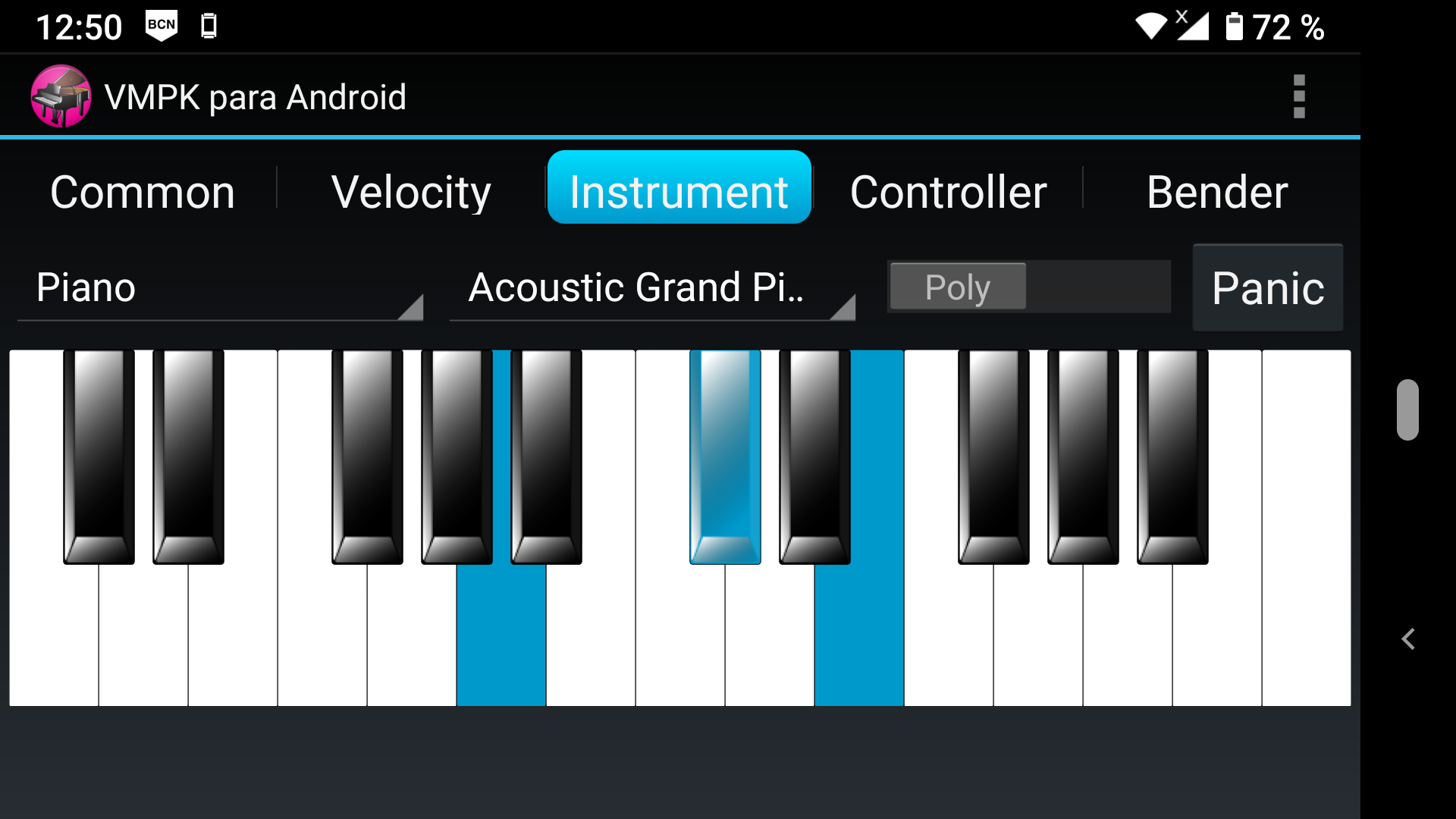
Another event to celebrate is the first 2 million downloads of VMPK for Linux, Windows and Mac. The Sourceforge statistics do not include the installs thru Flatpak, but you may realize that more than 75% of the Sourceforge downloads are the Windows packages. The 2 mil download happened some past day of this year 2025. I've promised a celebration, and now, I have released the Android port of VMPK under the GPLv3 license in GitHub.

VMPK Screenshot

You may download it from GitHub (source code and APK), or you may get it from the IzzyOnDroid repository which is available in the F-Droid app, but also on Neo-StoreDroid-ify,  and the unofficial IzzyOnDroid app.

If you already have the F-Droid app, you only need to add the IzzyOnDroid repository in Settings>Repositories and install it today, or you may prefer to use the official F-Droid repo.

I would like to add to the celebration a video live streaming concerto, but I am too lazy and odd playing for that. Better use this wonderful rendering of the Tchaikovsky Violin concerto by TwoSet Violin, with Brett Yang playing the soloist and Eddy Chen the rest of the orchestra. Enjoy!

Sunday, April 3, 2016

Taking Back From Android


Android is an operating system developed by Google around the Linux kernel. It is not like any other Linux distribution, because not only many common subsystems have been replaced by other components, but also the user interface is radically different based on Java language running into a virtual machine called Dalvik.

An example of subsystem removed from the Linux kernel is the ALSA Sequencer, which is a key piece for MIDI input/output with routing and scheduling that makes Linux comparable in capabilities to Mac OSX for musical applications (for musicians, not whistlers) and years ahead of Microsoft Windows in terms of infrastructure. Android did not offer anything comparable until Android 6 (Marshmallow).

Another subsystem from userspace Linux not included in Android is PulseAudio. Instead, OpenSL ES that can be found on Android for digital audio output and input.

But Android also has some shining components. One of them is Sonivox EAS (originally created by Sonic Network, Inc.) released under the Apache 2 license, and the MIDI Synthesizer used by my VMPK for Android application to produce noise. Funnily enough, it provided some legal fuel to Oracle in its battle against Google, because of some Java binding sources that were included in the AOSP repositories. It is not particularly outstanding in terms of audio quality, but has the ability of providing real time wavetable GM synthesis without using external soundfont files, and consumes very little resources so it may be indicated for Linux projects on small embedded devices. Let's take it to Linux, then!

So the plan is: for the next Drumstick release, there will be a Drumstick-RT backend using Sonivox EAS. The audio output part is yet undecided, but for Linux will probably be PulseAudio. In the same spirit, for Mac OSX there will be a backend leveraging the internal Apple DLS synth. These backends will be available in addition to the current FluidSynth one, which provides very good quality, but uses expensive floating point DSP calculations and requires external soundfont files.

Meanwhile, I've published on GitHub this repository including a port of Sonivox EAS for Linux with ALSA Sequencer MIDI input and PulseAudio output. It also  depends on Qt5 and Drumstick. Enjoy!

Sonivox EAS for Linux and Qt:
https://github.com/pedrolcl/Linux-SonivoxEas

Related Android project:
https://github.com/pedrolcl/android/tree/master/NativeGMSynth

Friday, December 27, 2013

VMPK for Android

Hi, Blog!

A lot of time since the last post. Let me announce a new port of VMPK, for Android  (4.x) devices. It is available in Google Play.


There are two apps, a paid version (0.5€) and a free one (gratis) with a small advertisement. It is not based on Qt, and it is not open source. It is a Java port rewritten from scratch using the native Android MIDI synthesizer and native Android themes. But on the other hand, is quite similar to the old N9 port, as you can see in the following screenshots, but with several additional features.


Being mostly a Java app, it includes some C code. The internal MIDI synthesizer is Android's "Sonivox EAS", which is part of AOS. The library is included in all recent Android versions, but it is not a public API, so I've compiled the library with a customized configuration and different features resulting a smaller binary and included it in the APK along with some other native code, mainly opensl_stream by Peter Brinkmann for interfacing the synth with Android's OpenSL ES audio output. An interesting aspect of the synth is the embedded GM soundfont using very small amount of memory, and not needing external data files.

Some features are: ipMIDI compatibility (MIDI OUT only) using UDP multicast and Wireless network. Accelerometer driven sliders for velocity, controllers and bender (like the N9 port), configurable number of keys and initial key, among other goodies.


Happy holidays!

Sunday, September 11, 2011

SoundFonts want to be free

A "SoundFont" file  (suffix .SF2) is a definition of one or several musical instruments, which can be used with synthesizers (hardware or software) to render, or convert musical notes (eg MIDI files, suffix. MID) into digital sound, which can be used by an audio interface and speakers to play music. Another file format for the same purpose is DownLoadableSounds (suffix. DLS). Both include sound samples that can be entirely synthetic or digitized from real instruments.

General MIDI is a very popular specification, that among other things define a palette of instruments. The instrument #1 is a piano, #41 a violin, #57 trumpet, #74 flute... GM SoundFonts offer 128 instruments arranged in that particular order. GS and XG are extensions of this specification.

Linux needs GM soundfonts that could be distributed together with GPL programs, similar to the need of typographic fonts for text rendering applications. Many Linux distributions incorporate the FluidR3 soundfont in their repositories. It is free and produce good quality sound, but is not small: more than 140 megabytes. MuseScore distributes "TimGM6mb" soundfont, which "only" weights 5.8 megabytes.

There are several software synthesizers using SoundFonts. Well known are FluidSynth and TiMidity++, both with free licenses. One lesser known, but no less interesting, is Gervill. It is part of OpenJDK, and therefore GPLv2 licensed. It is implemented in Java, of course. I am not very fond of Java, and I do not usually use it except for commercial projects when the customer requires their use, but this time I will do it only for fun.

Gervill can use SoundFonts, DLS, or WAV files. A very interesting feature is the so-called "Emergency Soundbank", used when no other external SoundFont is available. Definitions of this SoundFont instruments are fully synthetic and follow the GM standard.

This EmergencySoundbank is a Java class, and does not reside on a file, therefore it can not be used on another synthesizer. However, nothing prevents us from creating a Java program that instantiates the class, and stores the instrument definitions on a disk file. How complicated may this program be? Let's see:

$ cat MakeEmergencySoundfont.java
import com.sun.media.sound.*;
public class MakeEmergencySoundfont {
        public static void main(String[] args) throws Exception {
                SF2Soundbank sf2 = EmergencySoundbank.createSoundbank();
                sf2.save("GervillEmergencySoundbank.sf2");
        }
}


7 lines is not much after all. Let's compile it:

$ javac MakeEmergencySoundfont.java
MakeEmergencySoundfont.java:5: warning: com.sun.media.sound.SF2Soundbank is internal proprietary API and may be removed in a future release
                SF2Soundbank sf2 = EmergencySoundbank.createSoundbank();
                ^
MakeEmergencySoundfont.java:5: warning: com.sun.media.sound.EmergencySoundbank is internal proprietary API and may be removed in a future release
                SF2Soundbank sf2 = EmergencySoundbank.createSoundbank();
                                   ^
2 warnings


We have earned two warnings for the naughty boys, because it is ugly to directly use classes in the namespace "com.sun.media.sound.*", and if the Oracle finds out our prank, he could lock the pantry. Here, take another cookie, Neo...

To compile and use this program you only need OpenJDK6 (runtime and compiler). For older Java versions you can get a "gervill.jar" from the project website.

Running the program produces a SoundFont file:


$ java MakeEmergencySoundfont
$ ls GervillEmergencySoundbank.sf2
-rw------- 1 pedro users 1.8M 2011-09-11 12:50 GervillEmergencySoundbank.sf2


The result weights less than 2 megabytes. Of course the quality of the SoundFont is not high, but it is better than installing nothing at all by default, leaving users wondering what do they need to hear something in their programs that depend on software synthesizers.

It is interesting that a similar technique, also very simple, can be used to produce other SoundFonts based on samples of arbitrary sounds. For more details, see the MakeSoundFont example in Gervill's repository.

Finally, a question remains about what license we can use to distribute the file "GervillEmergencySoundbank.sf2" generated by our program. As a general rule, the output of a GPL program has no restrictions. However, in this case the program output does not come from processing input data, but simply dumps the results of running the algorithms included in the EmergencySoundbank class. To play it safe, we should release it as GPL.